Thursday, January 19, 2012

Stench and stained glass


If a magical time machine picked you up from 2012 and dropped you into a medieval village in Europe, say in 1312, you'd be surprised in ways you wouldn't expect.

Take just one example: you'd probably be overwhelmed by the stench in the air.

The foul odors would come in part from the people themselves. They wore the same unwashed clothes day after day after day, and they rarely bathed. That, and the lack of sanitation -- with animals and peasants living literally cheek by jowl -- made the Middle Ages rank.

There wouldn't be many signs or any readily available written material. The center of what knowledge there was and the prime instructions for a peasant's daily life came from religious leaders.

Thus, almost always, there was a place of Christian worship -- a Catholic church, since Christianity had not yet splintered. Attendance was mandatory. Within walking distance there might be one of the new Gothic cathedrals that were springing up like weeds all over Europe. Towns competed for pilgrims (religious “tourists”) by building the biggest, the tallest, the most spectacular of edifices. Inside, most displayed a relic guaranteed to attract the faithful: a piece of the true cross, a remnant of Mary’s robe, a tattered fragment of the tablecloth from the Last Supper, or a gilded reliquary holding the remains of the Three Wise Men.

Here's another thing that might surprise you: Many of these new cathedrals featured a then-new art form: magnificent stained-glass windows illustrating Bible stories.

The church, which had emerged as the power in Europe after the collapse of the Roman Empire, ruled equally with the nobility (and often trumped the nobility). The church cemented its harsh rules and complete control over the population through the use of imagery. Peasants were ignorant, and their ignorance stemmed from illiteracy. The advent of stained-glass windows gave the church another means to teach peasants all that the church thought they needed to know.

Be obedient. Do your duty to God -- and the church.

Or risk the hellfire of eternal damnation.

However, the rules and the images, quite predictably, were not always aimed so much at saving immortal souls as at sustaining the power and wealth of the church. Knowledge is power. Absolute power corrupts absolutely.

As tourists today, we focus more on the splendor of those stained-glass windows and less on the hidden purpose of the stories they tell.

The ecclesiastical architecture contrasts starkly with the primitive life of the 13th century, when Gothic cathedrals became a way for a town to make its mark. Peasant and nobleman alike understood next to nothing of what we now take for granted -- about disease transmission, about food preservation and safety, about what might lie ahead in the next village or across the river, or even about accurately tracking the passage of the day's 24 hours.

They got up when dawn broke, worked all day, gathered around a fire in the evening, and slept when it got dark. They lived life as their priest said it should be lived, and life was harsh, and dirty, and smelly.

I was reminded of all of this as I browsed through pictures I took of Gothic abbeys and cathedrals during the past 50 years. The stories depicted in the stained-glass windows created in this fearful and brutal time were designed to comfort the obedient and frighten the hell out of anybody who disobeyed. The stone carvings met the same ecclesiastical needs. Even the gargoyles were symbolic. The striking examples you see above are atop Notre Dame Cathedral in Paris. They signaled to worshipers that they were safe in church with such fearsome creatures facing outward, keeping the Devil at bay.

I began my amateur exploration of Gothic cathedrals as most explorations begin: superficially. I was absorbed by the age and majesty of the cathedrals. As is often the case when one learns more, I found more than I expected.

You can visit a medieval cathedral today and not be assaulted by the smell of unwashed bodies and animal excrement on dirt floors. Tourists today read guidebooks as they stroll before altars. Very few of today's visitors are illiterate, and the images and sculptures have lost much of their visceral impact.

The church has fragmented. For many today, religion does not play a dominant or even frightening role in life.

But look closely and skeptically at medieval cathedrals and you'll see not just soaring architectural achievement (and there certainly is that to be considered) but also stark anthropological evidence of a church that exercised autocratic control over every aspect of life and clung to dominance through the fears and the illiteracy of the faithful.

And take a deep breath: The 21st century smells far better that the 13th did.

Friday, January 13, 2012

Chatting about the pluperfect subjunctive


So which is it? Grey? Gray?

Or does it matter? Pick one of the two consistently and you'll probably say a little bit about yourself. But not much. Grey is more common in Great Britain. Both versions are acceptable in American English.

Is it theatre or theater? The difference is slightly more refined in American English. Theatre is the way people in the theatre world spell it. People who are not in the theater here use the "-er" version. Theatre is preferred for all uses in England.

We are indeed divided by a common language.

Not all of the lessons about grammar, usage and spelling that Miss Thistlebottom taught me in 4th grade are still -- or ever were -- universal. English varies all over the world. It is a wonderful and flowing thing that morphs and changes and refreshes itself day by day.

That's my takeaway from belonging to an e-mail discussion group about the English language. The group is populated primarily by copyeditors, but it also includes people who enjoy using, knowing about, and playing with English.

The list includes people who make their living in America and Great Britain. But there are also people from Down Under, Africa, South America, East Asia and Europe. The rules can be very different from region to region. Tell a Brit you got a new vest for Christmas. There will be confusion.

There's a lot of variety in and little consensus about English. There are those who hold that English should be slow to change and adapt. Others passionately promote moving the language forward. (Does anybody want to decline the verb "spring?" "Sprung" is showing up more and more as the past tense. I learned that it should be "sprang" and I'm sticking with it.) The Prescriptivists prescribe how English ought to be used. The Descriptivists describe how it is used.

Discussions can delve into true arcana. A thread about the appropriate use of the semicolon has continued for the past four days on the copyediting list. The question is not settled, and the arguments are authoritative and deeply felt.

The occasional punfest provides diversion. These word people can be the best of the best at puns, and there has been many a keyboard around the world splattered by a mouthful of morning coffee after an especially delicious pun causes a real-life spit-take.

Topics like the grocer's apostrophe ("apple's -- 99 cents per pound") pop up for discussion occasionally and can be entertaining. But over the 10 years I've been a member, we've ridden that high horse enough. Not everybody is a word expert, and the true bottom line is that communicating information is what's important, with content often trumping style.

But the copyeditors list is an important part of my day. I learn. I contribute to others learning. I crack a word joke occasionally. And I have become much less rigid in what I expect from English speakers and writers, from grocers to novelists to academic authors. I'm not a Descriptivist; I'm now a mellowed Prescriptivist.

I like the line that one of the contributors to the copyeditors list has used occasionally below his signature. He quotes James Nicoll, best described as a lover of language and an Internet "presence":
The problem with defending the purity of the English language is that English is about as pure as a cribhouse whore. We don't just borrow words; on occasion, English has pursued other languages down alleyways to beat them unconscious and rifle their pockets for new vocabulary.

Things change.

All things.

(The cool graphic above is of the words that are most commonly used in English proverbs; size indicates frequency. For more information on the e-mail copyediting group, click here.)

Wednesday, January 11, 2012

Pain and the art of stoicism


I swear before god that my first dentist had a setup like you see above in the corner of his office.

He didn't use it anymore, but it still managed to scare the heck out of me. Even without such a display, going to the dentist in those days was almost always painful.

His office was upstairs from the shoe store on the southwest corner of 25th and Marshall streets on Church Hill. The single pleasant aspect to going to the dentist was that, afterwards, we'd go to the shoe store downstairs and stand on a machine and look down at a screen to see a fluoroscope of our shoes and the bones in our feet. We kids thought it was great fun.

It was meant as a tool for fitting shoes, but ... what were they thinking?

They obviously weren't thinking about the X-rays bombarding our feet, that's for sure.

But I digress.

We went to the dentist upstairs from the shoe store because that's where my mom had always gone. She, too, had grown up on Church Hill. By the time I got to him, probably when I was about 6, my mom's dentist was an old man.

So was his equipment. Not as old, mind you, as the antique chair and drill he kept as a display in the corner. But old, even by late 1940s standards.

There was another downside to this elderly dentist: He didn't yet "believe" in Novocaine, which was still in its infancy in dentistry. Generations had endured the pain of his drill un-numbed. Why shouldn't the next? Pain makes you stronger.

A few years later, our church hired an organist whose husband was just starting out in dentistry. He used Novocaine. We switched to him immediately, and he was my dentist until he retired.

By this time I was all grown up and working at the Virginia Museum of Fine Arts. As I started casting about for a new dentist, I learned about the woman who had made the fangs for the Virginia Museum Theatre's production of "Dracula." I decided she would be my new dentist.

That didn't last long. She moved to, I think, Northern Virginia.

Again I had to find a new dentist, so I asked my periodontist - yes, I now had a periodontist -- if he would recommend a new dentist. "A woman, maybe," I suggested, ever on the lookout for a gentle touch.

"There are no good women dentists," he told me. Then he recommended Pat, who was moving back to Richmond and taking over her late father's practice. (My periodontist, who is also now retired, had a dry, stiletto-sharp sense of humor.)

Because I had an appointment with Pat today, I was reminded of that ancient dental drill from my childhood memories.

Pat uses Novocaine and 21st-century equipment. She was preparing to install a crown a few years back and asked me if I'd like an electronic back-massage pad for the chair.

I declined.

Call me a stoic.

Monday, January 9, 2012

On the path to paradise


It's not the oldest abbey I've ever visited.

But it's the most breathtaking.

In my first minutes on Mont Saint Michel, all I could think of was how many millions of feet had walked up its narrow streets.

There's a sheen to the cobblestones, worn smooth over thousands of years. The stone steps are uneven across their length where merchants and pilgrims, high priests and monks, tourists and their guides, have climbed up and down its 300-foot height.

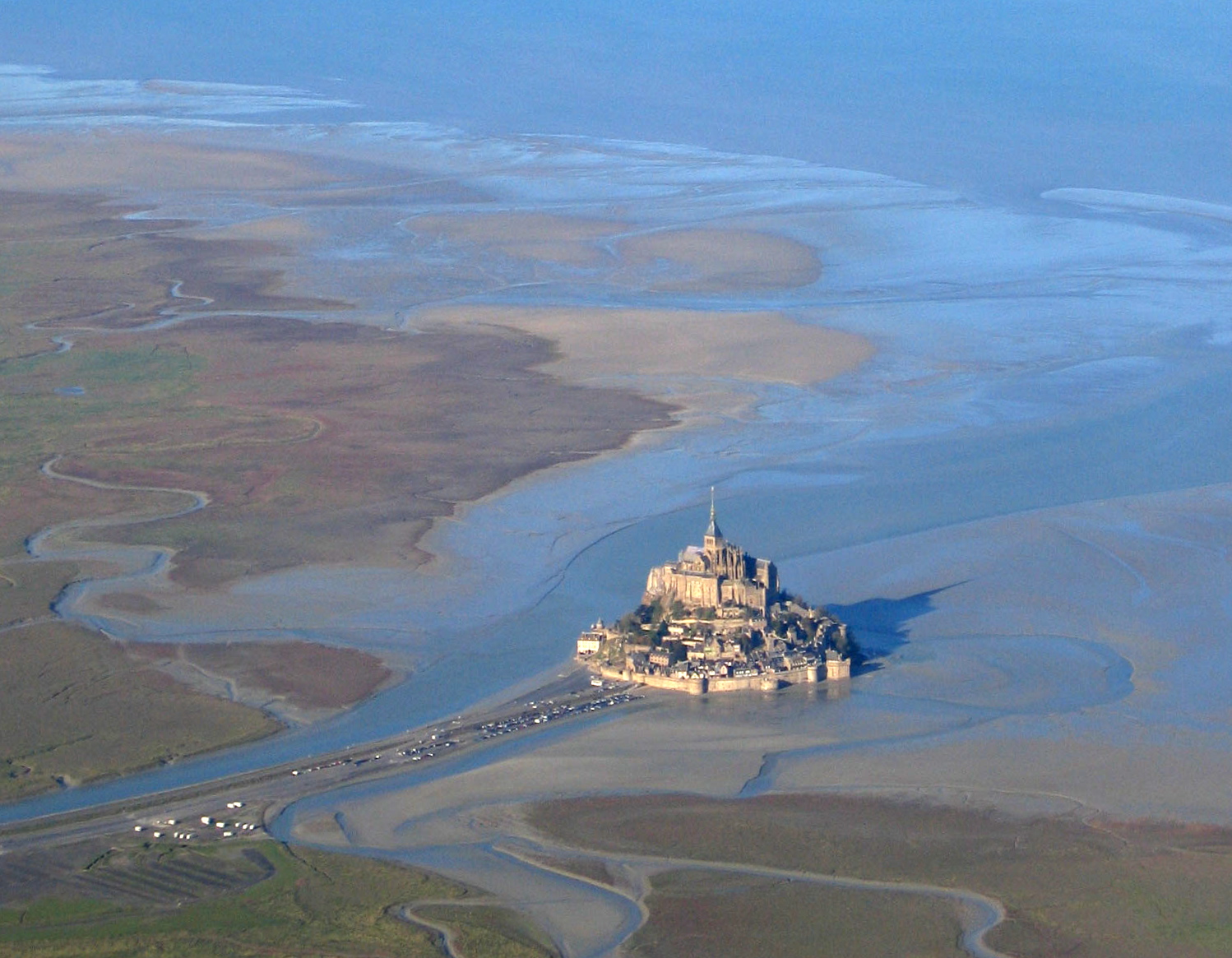
Click here for an overview of the mountain, which rises out of tidal flats about half a mile off the French coast. It stands at the mouth of a river near Avranches, the scene of a World War II breakthrough led by Gen. George S. Patton right after D-Day.

At a restaurant on the street you see above, in 2004, I ate one of the town's signature omelets. It had been whipped so long and so vigorously that it seemed to be more soufflé than omelet. It lopped over the edges of a dinner plate and stood about two inches high. It was all air and eggs and cream and butter.

The estuarial flats that surround the island can be killers. The tide comes in much faster than a man can run. They built a causeway in the late 19th century. Now tour buses park just a few steps from the entrance to the town, at the base of the mountain.

Mont Saint Michel survived the downfall of the Romans in the 5th century and was a Romano-Breton stronghold in the 6th and 7th centuries until the Franks sacked it.

The first monastery came along in the 8th century. It's a gory story. Legend has it that the Archangel Michael appeared to the bishop of Avranches in 708 and instructed him to build a church on the island. The bishop ignored the instruction until the archangel burned a hole in the bishop's skull with his finger.

Ouch.

In 1067, a year after the Battle of Hastings, the monastery of Mont Saint Michel gave its support (becoming rich in the process) to William the Conqueror in his claim to the throne of England. Pilgrimage, which is just a religious word for tourism, made the island and its monastery even richer.

And the crush of visitors began to wear down its cobblestones and steps.

Today, 41 people live on the island. But more than three million tourists visit Mont Saint Michel each year. Most, if not all of them, climb to the abbey along narrow streets that for a thousand years were called "paths to paradise."

From its heights, the 360-degree view of the English Channel, the impressive but deadly tidal flats and the Normandy coastline is, to say the least, spectacular.

Mont Saint Michel is inevitably teeming with tourists during the daytime. But at night, after the buses head back across the causeway and the day-trippers leave, the island is transformed back into a small, intimate village that is far more satisfying to the soul. The streets are quiet. Lights can be seen shimmering far away on the coast and on ships in the Channel. The sky twinkles with the light of thousands of stars.

I ran across an old postcard of the island at twilight the other day. In the picture, the sun is setting behind the island and streaks of purple, orange and charcoal streak the sky. It reminded me that Mont Saint Michel is one of the most beautiful places I have ever seen.

Sunday, January 8, 2012

Neighborhood watch


Look for Isabella if you come for a visit. She'll be the one on the sidewalk wrapping herself around your ankles and insisting that you take a moment to pet her.

Do it. She's a sucker for attention.

Isabella, seen here yawning after a catnap in the sun on the front sidewalk, is the neighborhood greeter.

Isabella lives across the street, catty-corner -- if you'll pardon the word -- from my house. If it's a nice day, meaning no heavy rain or snow, she'll be there at some point to greet you as you come and go. She's not asking for a handout. Miss Congeniality just wants to be acknowledged. And to offer a little love in return.

Isabella also keeps us safe -- by her standards. I've seen her in a snarling, twilight standoff with a possum in my front yard. (It was a draw.) I've seen her deftly chase off bigger tomcats who are encroaching on her territory. (Okay, it's 2012 and they were probably neutered before they were adopted from the SPCA and microchipped so they can be tracked by orbiting satellites, but still ...) I've seen her do that cat stare-down thing with large dogs, who then hang their tails and walk away with as much pride as they can muster. And I've seen her methodically stalking the odd chipmunk or a random leaf.

But when her neighborhood duties are complete, she follows the sun and looks for love.

Isabella is clearly well-cared for and loved at home. But she's equally at home outdoors.

This 10-pound, sleek and glossy black cat is also street savvy. She stays out of the way of cars and looks both ways before she crosses.

And she'll take a quick minute for a belly rub if you have the time.

Isabella has more than enough love to give, and the neighborhood is the better for it. You might say she belongs to all of us.

She'd say we belong to her.

Wednesday, January 4, 2012

The seeing eye


Five hundred and seventy-seven pictures.

Yep. As of late yesterday, that's the number of pictures my great-nephew Carlos had taken with the digital camera I gave him for Christmas.

His little sister, Milagros, is in a lot of them, including the one above. As a model, she's close at hand, and she works cheap. I asked Carlos to send me his favorite picture so far, and that's the one he picked. (The skateboard she's sitting on was a present to Carlos from Santa.)

But in terms of raw numbers, Milagros is running second to the tree in his front yard, cars parked in his neighborhood, and, for some reason that only Carlos understands, close-ups of license plates.

In short, he's become a photography fanatic at the age of 7.

I gave Carlos the simple digital camera for Christmas because I remembered how much fun I had when my mom gave me her old Kodak box camera and a roll of 120 black-and-white film when I was about his age. I doubt very seriously, though, that I ever shot as many as 577 pictures when I was 7. Film, flashbulbs and processing cost money. That was a limiting factor indeed in 1949.

But in the digital age, Carlos doesn't have that problem. He can shoot whatever strikes his fancy and never give a thought to what it will cost to see the results. Because there is no cost. And when he fills up his camera's SD card, his parents can transfer the images to the family computer, erase the memory card, and he can fill it up all over again.

I hope he saves each and every image he takes as he discovers the joys of photography. Even the silly ones. The rules of composition and lighting can come later, and still later he'll learn how to break the rules for effect. But for now, just shooting what's around him is what's important.

Carlos doesn't realize it yet, but he's learning to see, to observe life as it's happening. And to preserve memories.

So, Carlos, here's an assignment -- should you choose to accept it. Identify the most interesting thing in your yard. Shoot lots of pictures of it. In a week or so, send me the one you think is the best. I'll post it here for all to see.

Monday, January 2, 2012

Sunday mornings with CBS


My Sunday mornings are spent -- religiously, if I may be forgiven for saying that -- with "CBS News Sunday Morning."

I've rarely missed an edition of the program since it first aired on Jan. 28, 1979. It was dreamt up by two giants of television's second generation, Charles Kuralt and Robert "Shad" Northshield.

The program was designed to be a sophisticated TV version of a Sunday newspaper magazine supplement. That's still the formula, all these years later, although Charles Osgood has succeeded the late Charles Kuralt as the host. Osgood is no Kuralt -- there'll never be another -- but he's almost as good.

"CBS News Sunday Morning" is laid back by comparison to any other news program. It's almost languid in style, just perfect for greeting a Sunday morning with coffee in hand. Nothing is rushed. Nothing is over-produced. Nothing is cluttered.

Sure, it opens with a short summary of the latest news, intelligently written. But the remainder of its 90 minutes is filled by the kind of in-depth stories and features and personality profiles that you find in the lifestyle section of a good newspaper -- stories that usually aren't covered on TV.

Its stock in trade are pieces on the arts, architecture, music, ballet, design, and interesting people who do interesting things, either because they just want to or because they want to make their world a better place. Perhaps the most extreme example of the program's respect for its audience came in 1986, when the entire 90 minutes was devoted to a live broadcast of a historic piano recital in Moscow by Vladimir Horowitz.

From it's inception, "CBS News Sunday Morning" has violated several cardinal rules of TV journalism in its final segment. It's my favorite part of the broadcast. Videographers are set loose across the world from the usual restrictions to present simple visual essays on nature, with no soundtrack other than the location itself and no narration at all. Whether they be scenes of graceful ducks in a pond or an undulating field of Texas bluebonnets gently waving in a breeze, they're simple perfection. They offer moments to reflect on our world and perhaps listen to the quiet buzz of a bumblebee. This week's nature segment focused on grey wolves in the wild.

My only complaint is that these delightful essays are too short. They're somewhere shy of 60 seconds now, although they used to be longer when the program debuted. Like everything else about TV, "CBS News Sunday Morning" has succumbed to the tempo of the times, although not by much. The signature Sunday morning nature essays are still there, still achieving what they've always achieved. And I look forward to a restful treat for jaded sensibilities as I wrap up the weekend and gird myself for another new week.